
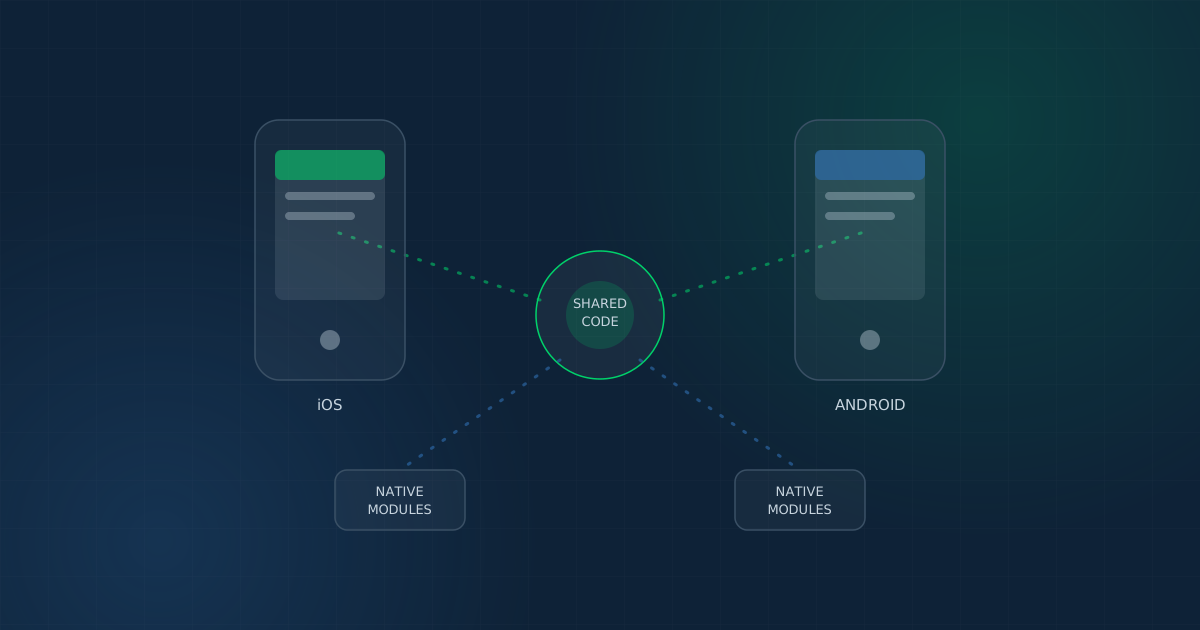
Every mobile app development conversation eventually lands on the same question: native, Flutter, or React Native? And it usually gets answered with a preference instead of a requirement. Here's the framework that should actually drive the decision.
Every mobile app development conversation eventually lands on the same question: native, Flutter, or React Native? And it usually gets answered with a preference instead of a requirement — "we've always used React Native" or "Flutter is faster to build." Those are real factors, but they're not the deciding ones. The deciding ones are what the app actually needs to do, for how long, and at what level of performance.
What "Cross-Platform" Actually Means Today
Cross-platform no longer means a compromised app. Flutter and React Native both power production apps used by millions of users, including apps from major consumer brands. The compromise, when it exists, shows up in specific places — not everywhere.
Flutter compiles to native code and draws its own UI layer using the Skia rendering engine, which means visual consistency across iOS and Android is close to identical. The tradeoff is a larger app size and a Dart codebase that's less common than JavaScript, which can affect hiring.
React Native renders through native components and uses JavaScript, giving it a larger talent pool and easier integration with existing web teams. The tradeoff is more frequent reliance on native modules for complex device features, which can erode some of the "one codebase" cost advantage.
Fully native (Swift for iOS, Kotlin for Android) gives complete access to platform capabilities and the smoothest possible performance, at the cost of maintaining two separate codebases.
The Requirements That Should Actually Drive the Decision
How performance-sensitive is the app? Apps doing heavy graphics processing, real-time AR, or complex animations benefit from native's direct hardware access. A standard CRUD-style business app, a booking platform, or a content app rarely needs that level of performance headroom.
How deep is the hardware integration? Apps depending on Bluetooth peripherals, advanced camera processing, or background sensor data often need native modules regardless of framework — at which point the "cross-platform savings" narrows significantly.
What's the 2–3 year product outlook, not just the launch requirement? A framework decision made for a simple MVP can become expensive to reverse once the app has scaled. If the roadmap already includes features that stress a framework's limits, it's worth building for that roadmap now rather than migrating later.
What does the existing engineering team know? A team fluent in React and JavaScript will move faster in React Native. A team with strong Dart or a clean slate has less friction adopting Flutter. This isn't the deciding factor on its own, but it's a real cost and speed variable.
Is design consistency across platforms a business requirement? If brand and UI consistency between iOS and Android matters more than platform-native look and feel, Flutter's rendering approach tends to deliver that more reliably out of the box.
A Practical Decision Framework
- Content, booking, e-commerce, or business apps with standard UI patterns: Flutter or React Native
- Heavy AR/VR, real-time graphics, or advanced hardware integration: Native
- Existing team strong in React/JavaScript, web-to-mobile expansion: React Native
- Brand-critical UI consistency across platforms, new team: Flutter
- Long-term flagship product where performance ceiling matters: Native, or plan a native migration path from day one
Where Enterprises Get This Wrong
The most common mistake isn't picking the "wrong" framework — most frameworks can technically deliver most apps. The mistake is picking a framework based on cost alone, without checking it against the 2–3 year roadmap. A cross-platform MVP that later needs deep hardware integration doesn't get a clean upgrade path; it gets a rebuild. That rebuild costs more than building native would have cost in the first place.
The second most common mistake is underestimating QA and release complexity. Cross-platform doesn't mean cross-platform testing disappears — both iOS and Android still need dedicated QA cycles, device coverage, and separate App Store and Play Store release management, regardless of how much code is shared.
What to Ask a Development Partner Before Committing
- Can you show production apps you've shipped in the framework you're recommending, not just the one you default to?
- How do you handle features that need native modules within a cross-platform app?
- What's your QA and release process for App Store and Play Store submissions?
- If the roadmap changes in 18 months, what's the actual cost of extending vs. rebuilding?
The Bottom Line
Native vs cross-platform isn't a technology preference — it's a requirements match. Cross-platform frameworks like Flutter and React Native are strong, production-ready choices for the large majority of business, content, and commerce apps. Native remains the right call when performance ceilings, deep hardware access, or a long-term flagship roadmap justify maintaining two codebases. The framework decision made at kickoff should be tested against where the product needs to be in three years, not just what it needs to do at launch.
This same discipline runs through our Mobile App Development practice — matching the framework to the requirement, not the other way around, and it's the same logic behind choosing between a dedicated outsourced team and an in-house build for the engineering behind it.