
Ask three development shops what a SaaS MVP costs and you'll get three different numbers, often for wildly different reasons. The gap isn't dishonesty — it's that "MVP" means different things to different teams, and cost follows scope, not the acronym.
Ask three development shops what a SaaS MVP costs and you'll get three different numbers, often for wildly different reasons. One is quoting a proof-of-concept. Another is quoting a fully scalable, investor-ready platform. The gap isn't dishonesty — it's that "MVP" means different things to different teams, and cost follows scope, not the acronym.
What "MVP" Should Actually Mean
A minimum viable product is the smallest version of your idea that lets real users complete the core workflow and gives you honest signal on whether they'll pay for it. It is not a stripped-down version of your full product vision — it's a different, smaller thing built to answer a specific question.
The founders who spend the least and learn the most are the ones who can name that one core workflow precisely before writing a single line of code.
What Actually Drives MVP Cost
Core workflow complexity. A single-path SaaS tool (input → process → output) costs far less than a multi-role platform with different permission levels and interconnected workflows.
Third-party integrations. Payment processing, calendar sync, email delivery, and CRM connections each add scoping, testing, and edge-case handling — even when the integration itself is "just an API call."
Real-time features. Live collaboration, notifications, or dashboards that update without a refresh require different architecture than a standard request-response app, and cost more to build and test properly.
Multi-tenancy and scalability planning. Building for a single early customer is simpler than building infrastructure that safely isolates data across many customers from day one. Some of this can be deferred; some (like basic data isolation) usually shouldn't be.
Design maturity. A clean, functional UI built on an existing component library costs meaningfully less than fully custom UX design and animation work — and for an MVP, it's rarely the differentiator that matters yet.
A Realistic Budget Range
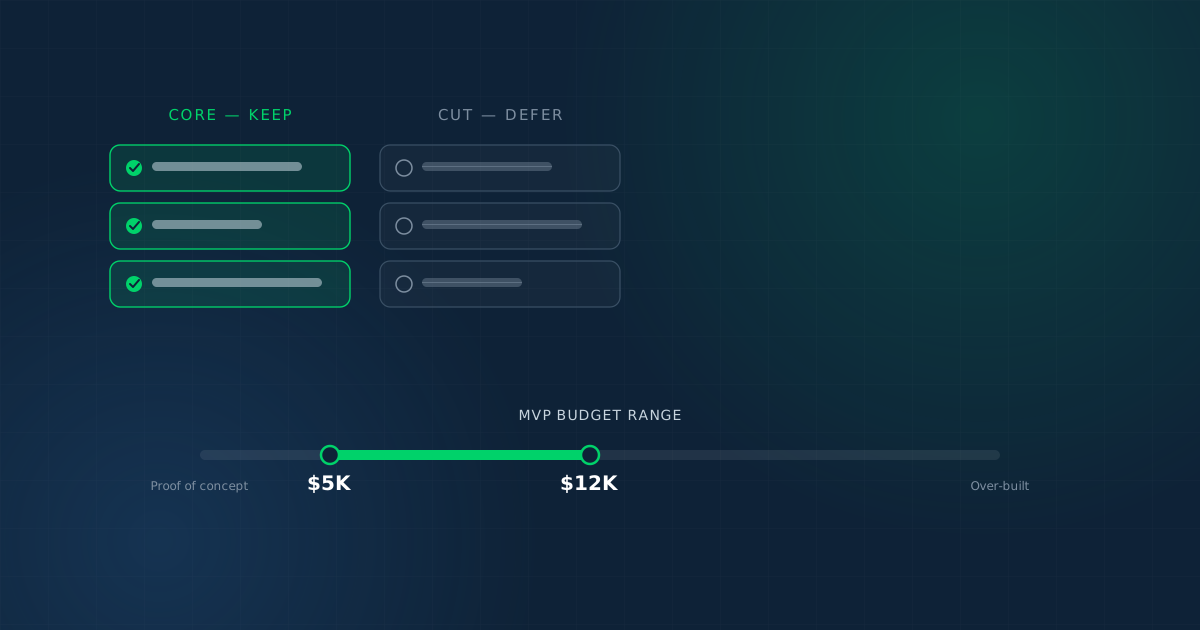
Most focused SaaS MVPs — one core workflow, standard authentication, a handful of essential integrations, functional (not custom) design — fall in the $5,000–$12,000 range. Below that, expect a proof-of-concept rather than something ready for paying users. Above roughly $15,000–$20,000, you're usually building more than an MVP requires, unless the product has inherent complexity (fintech compliance, real-time data processing, hardware integration) that genuinely can't be deferred.
What to Cut Without Hurting the Launch
- Admin dashboards beyond the essentials — build what you need to operate, not a full internal tool
- Advanced reporting and analytics — instrument the two or three metrics that answer your core question, defer the rest
- Multi-language and localization — unless your first customers require it
- Edge-case user roles and permissions — support the roles your first cohort actually needs
- Pixel-perfect custom design — a clean, credible interface beats a beautiful one that took six extra weeks
What Not to Cut
- The core workflow itself — this is the product; don't ship a demo of it
- Basic security fundamentals — authentication, data isolation, and encrypted storage aren't optional even at MVP stage
- A feedback mechanism — you're building this to learn; make sure you can actually capture what users do and say
No-Code vs. Custom Development
No-code and low-code tools can validate a genuinely simple idea in days, and that's a legitimate strategy for the earliest possible test. But most SaaS products — anything with real business logic, meaningful integrations, or a scaling roadmap — outgrow no-code tooling within months, and rebuilding on custom code later costs more than starting there would have. If you're planning to raise investment or the product has any technical differentiation, custom development on a framework like React or Next.js, with a proper API layer, is usually the better-value starting point despite the higher sticker price.
A Practical MVP Scoping Process
- Write the one sentence your MVP needs to prove true or false about user behavior.
- Map the single core workflow end to end — every screen, every decision point.
- List every feature you want, then mark each as core-to-the-workflow or supporting. Cut everything supporting.
- Identify unavoidable integrations (payments, auth) versus nice-to-have ones (CRM sync, advanced analytics) and defer the latter.
- Set a fixed scope before development starts — mid-build scope changes are the single biggest cause of MVP budgets doubling.
The Bottom Line
SaaS MVP cost isn't a single number because "MVP" isn't a single thing — it's whatever answers your core question with the least possible build. Most well-scoped MVPs land in the $5,000–$12,000 range and take 12–14 weeks. The founders who stay in that range aren't cutting corners; they're cutting everything that isn't the question they're actually trying to answer.
This is the same scoping discipline behind our Product & Startup Engineering practice — and once an MVP validates, it's worth deciding early whether to scale it with an outsourced delivery team and the cloud infrastructure to support real growth.